

The Trevor Project — Illinois Conversion Therapy Legal Accountability Guide
Ambika Law, PC is proud to announce that our founder, Amanda Simmons, served as a contributor to the newly released Illinois “Conversion Therapy” Legal Accountability Guide, a comprehensive resource designed to help survivors, attorneys, and mental health professionals understand their rights and pursue accountability when harmful conversion practices occur. This guide marks a significant step forward in protecting LGBTQ+ individuals and strengthening the legal tools available to challenge these discredited and dangerous practices.

Amanda Simmons Publishes “Judicial Solutions to End Institutional Child Abuse” in the ABA Judicial Division Record
Amanda Simmons, founder of Ambika Law, PC, authored “Judicial Solutions to End Institutional Child Abuse,” published in the American Bar Association’s Judicial Division Record (Winter 2025). Written for a judicial audience, the article pairs a candid account of the “troubled teen industry” with a practical Judicial Bench Card for Congregate Care Placements — a checklist judges can use to protect children before and during placement in a residential treatment facility.
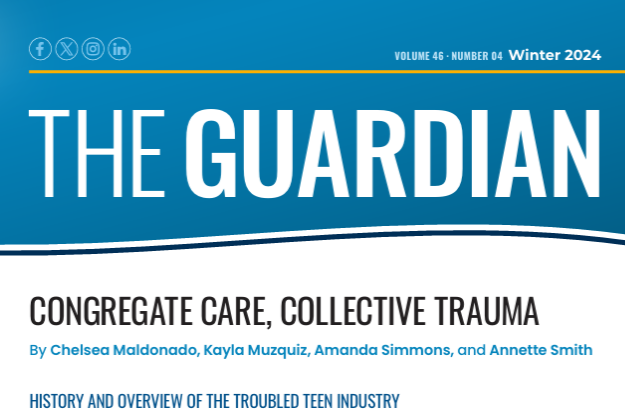
Amanda Simmons Co-Authors “Congregate Care, Collective Trauma” in NACC’s The Guardian
Amanda Simmons, founder of Ambika Law, PC, co-authored “Congregate Care, Collective Trauma,” the lead feature of the Winter 2024 issue of The Guardian, the quarterly law journal of the National Association of Counsel for Children (NACC). She wrote the piece alongside survivor-advocate and journalist Chelsea Maldonado, lived-experience advocate Kayla Muzquiz, and Oregon family defender Annette Smith. Written for the child-welfare bar, the article gives judges and attorneys a grounded overview of the “troubled teen industry” and practical guidance for protecting youth at risk of congregate-care placement.
Amanda Simmons Publishes “Partnering with the Judiciary to End Institutional Child Abuse in Residential Treatment Centers” in the NCJFCJ’s In Session Magazine
In the Summer 2024 issue of In Session, the member magazine of the National Council of Juvenile and Family Court Judges (NCJFCJ), Amanda Simmons, founder of Ambika Law, PC, published “Partnering with the Judiciary to End Institutional Child Abuse in Residential Treatment Centers.” The article makes a direct case to the bench: an educated judiciary is one of the most powerful and effective tools for protecting children from abuse in the so-called troubled teen industry.
Amanda Simmons publishes an article on juvenile strip searches in the Children's Legal Rights Journal
Attorney Amanda Simmons recently published an article in the Children’s Legal Rights Journal about juvenile strip searches in youth residential treatment facilities and the troubled teen article. Simmons’ article, “Sorry, Kid, You Have No Rights Here: How can we protect unadjudicated youth in private residential treatment facilities from harmful and unnecessary strip searches?” published in the Children’s Legal Rights Journal, explores the legal and ethical concerns surrounding the strip searches of unadjudicated youth in private residential treatment facilities.

Attorney Amanda Simmons publishes article about the troubled teen industry in the CA Women Lawyers Winter Newsletter
The American Bar Association recently adopted Resolution 605 at the 2023 Annual Meeting. This important resolution provides support for the Stop Institional Child Abuse Act and similar state, local and federal legislation that aims to prevent child abuse in youth residential treatment programs.

Amanda Simmons authors article on Resolution 605 and institutional child abuse for the ABA CRLC
Amanda Simmons, founder of Ambika Law, PC, recently authored an article for the American Bar Association (ABA) entitled “Resolution 605, the Troubled Teen Industry, and Institutional Child Abuse.” Published on August 21, 2023, this article highlights critical issues within the troubled teen industry and advocates for essential legislative reforms to protect vulnerable children from institutional abuse.