
Amanda Simmons Co-Authors “Congregate Care, Collective Trauma” in NACC’s The Guardian
Amanda Simmons, founder of Ambika Law, PC, co-authored “Congregate Care, Collective Trauma,” the lead feature of the Winter 2024 issue of The Guardian, the quarterly law journal of the National Association of Counsel for Children (NACC). She wrote the piece alongside survivor-advocate and journalist Chelsea Maldonado, lived-experience advocate Kayla Muzquiz, and Oregon family defender Annette Smith. Written for the child-welfare bar, the article gives judges and attorneys a grounded overview of the “troubled teen industry” and practical guidance for protecting youth at risk of congregate-care placement.
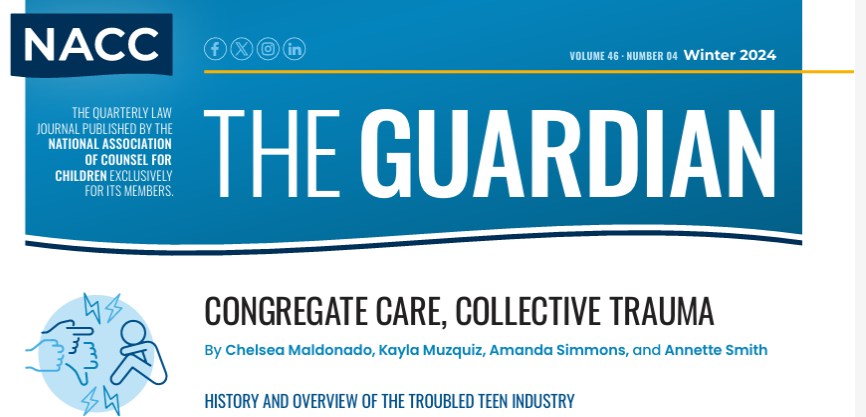
The Guardian is published quarterly by NACC, one of the nation’s leading membership organizations for child-welfare attorneys, and reaches its members directly — an ideal audience for a piece aimed at improving how lawyers represent children in and around residential treatment.

The article opens by mapping the scale of the problem. At any given time, as many as 200,000 children and teens are housed in residential treatment facilities (RTFs) — placed privately by parents and, increasingly, through the foster care, juvenile justice, and immigration systems. The bulk of these facilities are for-profit — some publicly traded, others backed by private equity — and they draw at least $23 billion in public funds each year, including dollars earmarked for public education, Medicaid, and Title IV. The authors trace decades of documented abuse and neglect, from early Government Accountability Office findings through the American Bar Association’s 2023 Resolution 605, and cite the 2024 Senate Finance Committee report Warehouses of Neglect, which concluded that these harms are “endemic to the RTF operating model.”
The piece then untangles a daunting legal and regulatory landscape. The industry grew in the wake of deinstitutionalization, and as facilities shifted from a private-pay to a public-pay model they came under a patchwork of federal oversight — the Department of Health and Human Services (through the Administration for Children and Families and Title IV-E, and through Medicaid/CMS), the Department of Justice (through the OJJDP and the Office for Civil Rights enforcing Section 504 and Title II of the ADA), and the Department of Education (through the IDEA’s guarantee of a free appropriate public education in the least restrictive environment). The authors highlight a fast-developing body of case law, including a November 2024 Maine settlement addressing the over-institutionalization of children with disabilities and a federal class action filed in Rhode Island — both building on Department of Justice findings that the unnecessary segregation of children with disabilities violates the ADA.
At its heart, the article is a practice guide. It urges attorneys who represent children to meet their clients personally — in person, in confidence, and regularly — rather than outsourcing those visits to social workers or relying on the accounts of others; to advocate for children to be placed as close to home as possible, and to access public-defense funds to visit those placed far away; to tour facilities and meet floor staff, not just the case manager or therapist; and to seek out and center lived-experience experts who have been through these programs themselves.
The article closes with a survivor’s call to action from co-author Kayla Muzquiz, who describes how a serious autoimmune condition went undiagnosed and untreated during her years in congregate care — an account that grounds the authors’ argument that a child’s biological health must come first and their call for stronger medical safeguards for children in state custody. Taken together, the authors write, research, case law, and policy have reached a growing consensus that institutionalizing youth is deeply harmful, and they urge the legal community to build community-based alternatives and to elevate the perspectives of those with lived experience.
The article reflects Ambika Law’s trauma-informed mission and Amanda Simmons’s ongoing work — across NACC, the ABA, and other national forums — to protect vulnerable children and hold institutions accountable.
Read the full article beginning on page 1 of the Winter 2024 issue of The Guardian (National Association of Counsel for Children): https://naccchildlaw.org/wp-content/uploads/2024/12/Guardian-2024-v46n04-r3.pdf