
When Placement Hurts: How the legal system can address the troubled teen industry (Webinar 3)
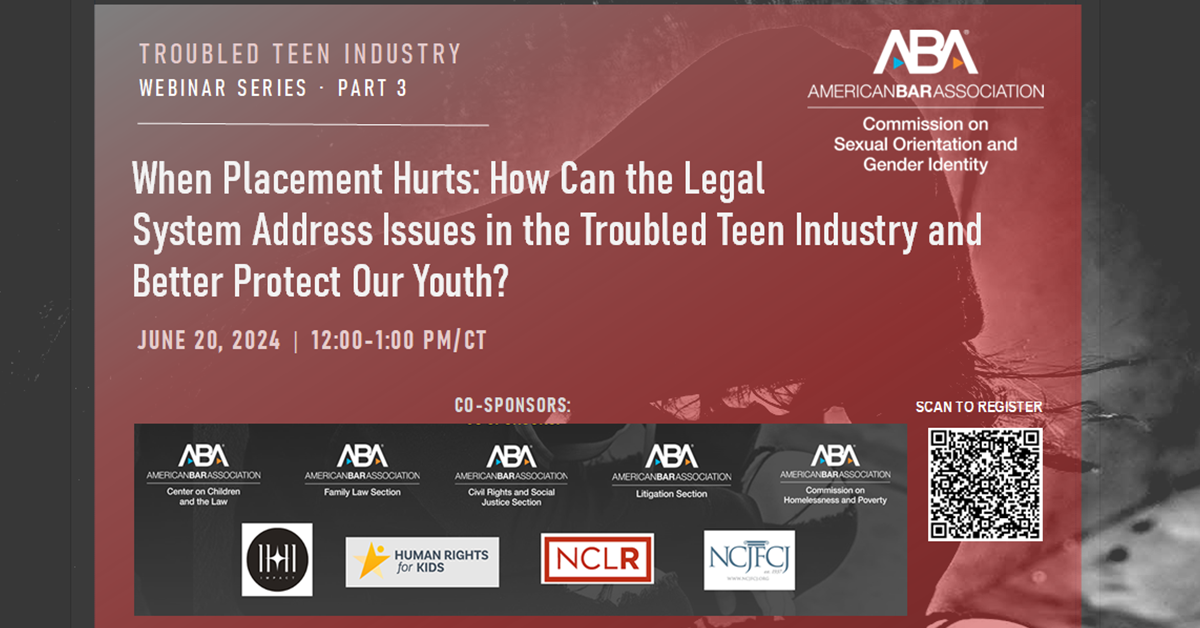
On June 20, 2024, Amanda Simmons, founder of Ambika Law, PC, moderated “When Placement Hurts: How Can the Legal System Address Issues in the Troubled Teen Industry and Better Protect Vulnerable Youth?” — the third and final installment of the American Bar Association’s three-part webinar series on the troubled teen industry, produced with the ABA’s Commission on Sexual Orientation and Gender Identity (SOGI).
Where the first two webinars traced the history of congregate care and the policy changes underway at the federal, state, and local levels, this session spoke directly to the practicing bar: what legal tools already exist to protect youth in residential treatment facilities, and how attorneys and judges can put them to work.
Drawing on her lived experience as a survivor of institutional child abuse, Amanda walked through the layered legal landscape governing residential treatment and debunked a common myth — that these facilities operate with little federal oversight. She mapped the federal frameworks that already apply, among them Title IV-E and the Family First Prevention Services Act, Medicaid/CMS standards for psychiatric residential treatment facilities, SAMHSA, the ADA, Section 504, IDEA’s guarantee of a free appropriate public education, and the Fair Labor Standards Act. She also highlighted the wide state-to-state variation in licensing, restraint-and-seclusion rules, and statutes of limitations, and the real progress possible through local tools like youth ombudspersons and wraparound services that keep children safely at home.
The conversation confronted the hardest problems in this space: loopholes created by inconsistent definitions of “residential facility,” courts treating publicly funded programs as “private entities” beyond constitutional reach, choice-of-law confusion, and the recurring patterns of abuse — strip searches, restraint injuries, labor and sex trafficking, educational and medical neglect, and deceptive marketing.
A closing panel gathered some of the field’s most respected voices: Judge Ernestine Gray and Joey Orduña Hastings, Esq. (NCJFCJ) on judicial approaches; Annette Smith, Esq. on family defense; Shannon Minter, Esq. (NCLR) on civil rights and trial strategy; and Guy D’Andrea, Esq. on creative litigation and impactful victim representation. Attendees left with practical resources, including an attorney checklist, a curated reading list, and state impact reports.
A recording of Webinar 3 is available through the American Bar Association: https://www.americanbar.org/groups/diversity/sexual_orientation/events_cle/webinar-series-troubled-teen-industry-2024/tti-2024-when-placement-hurts-part-3/